Learning from experience and turning that experience into improvement is essential for any modern military organization. This also includes identifying, adapting, and applying relevant lessons from others. In today’s rapidly evolving operational environment, the ability to learn and adapt with speed and accuracy is critical to achieving operational advantage.
Learn how DevCap accelerates the Lessons Learned process to support continuous improvement across military and defence organizations.
Organizational learning
Learning organizations can be defined as those that implement systems for learning from experience or aim to improve the systems they already have. These organizations typically follow three basic stages:
1. Identification — Collect learning from experiences.
2. Action — Take action to change existing ways of doing things based on the learning.
3. Institutionalization — Communicate the change so that relevant parts of the organization can benefit from the learning.
These stages form the foundation of an effective Lessons Learned process, ensuring that valuable experiences are assessed and, when necessary, integrated into the organization’s practices.1
Lessons learned in a military context
The term Lessons Learned is broadly used to describe people, things, and activities related to the act of learning from experience to achieve improvements. For NATO, Lessons Learned (LL) is essential to improve performance, reduce risks, increase efficiency, and enhance operational effectiveness. This is achieved through NATO’s LL capability, which constitutes a core component of NATO’s organizational learning and consists of the following key elements:
- Mindset — A culture that enables and encourages learning from others and sharing knowledge across the organization.
- Leadership — Effective decision-making, emphasizing the value of the NATO LL Capability and the creation of a learning environment.
- Structure — Designated and skilled LL personnel throughout the organization.
- Process — A common LL process.
- Tools — Technology that supports collection, storage, and sharing of LL information.
- Training — Providing personnel the skills and knowledge to fulfill their LL roles effectively.
- Information Sharing — The will to submit, receive, and reuse LL information that is reliable and credible.
The common LL process, outlined above, follows the three basic stages of learning described earlier: identification, action, and institutionalization. The process comprises two phases and a set of component steps, as outlined below. It systematically processes observed issues arising from an activity until either a Lesson Learned is reached, or not taken forward for institutionalization for defined reasons.2
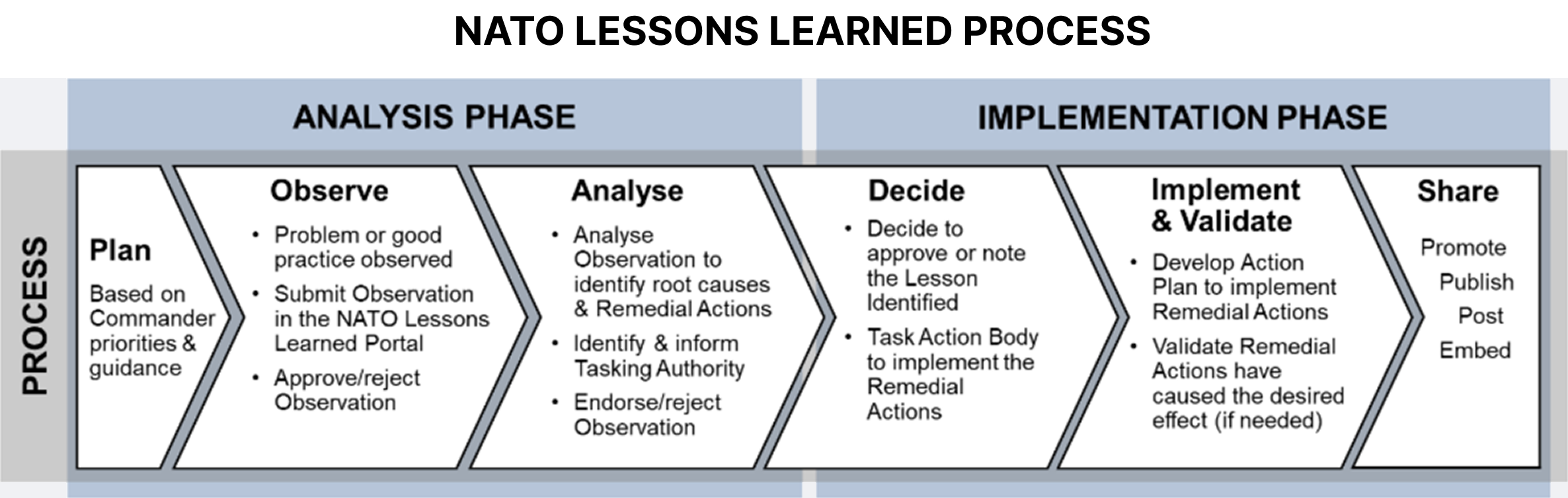
Source: NATO, JALLC: The NATO Lessons Learned Handbook (Fourth Edition), June 2022.
In fast-evolving operational environments, NATO acknowledges that a flexible yet structured approach to LL is necessary. In such situations, the process must be adapted to address unexpected issues rapidly, to prevent undesirable outcomes that could jeopardize achievement of priority objectives or hinder an adversary’s progress. The abbreviated LL Process should achieve as minimum the following:2
- Clear understanding of the observed issue.
- Rapid analysis to identify root cause and select the most effective remedial action. A remedial action is an activity or set of activities that corrects an issue identified for improvement or facilitates the implementation of a best practice.
- Streamlined decision-making and communication between relevant authorities to implement the action quickly.
- Confirmation that the remedial action resolves the issue, even if full validation is not possible within the timescales.
- Regular information sharing with affected parties to keep them updated and allow for necessary adjustments.
- Rapid dissemination of successful actions to allow affected parties to resume activities immediately.
Looking at ongoing conflicts, the importance of an adaptable LL process is evident. RAND research from 2025 on Ukraine’s defense highlights that the pace of technological development and the evolution of warfighting is unprecedented in recent history, underscoring the need for fast and effective LL processes. RAND recommends formalizing LL practices by leveraging experienced personnel to brief new units as they rotate to frontline positions, and prioritizing lessons learned implementation within more operationally experienced units. A approach that aims to foster a culture of learning by example, which can then be extended to the wider force, while minimizing the costs and inefficiencies associated with large-scale implementation.3
In March 2026, representatives of the Ukrainian Armed Forces highlighted the importance of aligning training activities more closely with operational realities, including relocating portions of basic training to Ukraine to accelerate the integration of combat experience into force development.4 This approach was reflected in the Swedish Armed Forces exercise Aurora 26, conducted in spring 2026, where Ukrainian units contributed frontline operational experience while acting as the opposing force (OPFOR), focusing on leveraging their expertise in drone operations.5
Both NATO frameworks and operational experience from Ukraine highlight the challenge of executing the Lessons Learned process at the speed, accuracy, and scale required to achieve operational advantage. This underscores the need for technology-enabled approaches capable of supporting fast-evolving operational environments. As operational structures and command relationships may evolve rapidly in response to changing conditions, digital support systems must also be sufficiently flexible to adapt to organizational change rather than being constrained by static hierarchies or predefined processes.
1 Milton, N. (2010). The Lessons Learned Handbook: Practical approaches to learning from experience (1st ed.). Chandos Publishing.
2 NATO Bi-SC Command Directive 080-006 (2018), Lessons Learned. NATO; NATO, JALLC. (2022). The NATO Lessons Learned Handbook (4th ed.). NATO.
3 Dee, S., et al. (2025). Lessons learned: Understanding the role of military organizational and adaptation culture for the future of Ukraine’s defence. RAND Corporation.
4 Livingstone, K. (2026, March). Role reversal: Ukraine moves training home and exports the lessons abroad. Defense News.
5 Ljungberg, H. (2026, April). From the Frontline in Ukraine to Aurora 26, April 2026. Swedish Armed Forces.
DevCap and the Lessons Learned process
DevCap® provides an integrated digital environment for Lessons Learned and experience management across organizational levels, aligned with NATO Lessons Learned frameworks.
Designed with an ecosystem approach, DevCap enables integration with mission networks, enterprise environments and external systems while supporting adaptable workflows and rapid feedback loops. A common operational picture supports decision-making and command-level oversight, while maintaining traceability and accountability throughout the Lessons Learned process.
Rather than replicating a fixed Lessons Learned process as a rigid digital workflow, DevCap provides flexible capabilities for Collect, Analyze and Act, enhanced by AI and agents. These capabilities can be used at different levels of complexity depending on the user’s role, responsibilities, permissions and operational context.
Collect
Plan, direct and standardize data collection across activities, units and organizational levels.
Create observations from any device and check them against relevant existing organizational knowledge, including previous observations, Lessons Learned, best practices, guidance and other relevant sources.
Continuously capture structured and unstructured data from users, units, activities and connected systems such as training support systems, LMS/ADL, simulators, sensors and the TAK Capability Suite.
Analyze
Create and customize aggregated data views, with drill-down from higher-level perspectives to underlying observations and data.
Process and analyze observations together with other relevant data and knowledge sources using different visualizations and analytical techniques to identify patterns, trends, recurring issues, potential best practices, root causes and possible remedial actions in collaboration with relevant stakeholders.
Structure, compare and explore data across different analytical dimensions — such as activities, units, objectives, locations and time — while maintaining traceability to the original source.
Act
Turn analysis results into recommendations, plans, actions and reusable knowledge products.
Assign responsibility, monitor implementation and outcomes over time, adjust actions when required, and validate their effect through structured feedback loops.
Create and disseminate lessons learned, proven practices, reports and other relevant knowledge products through both push and pull approaches, adapted to lesson maturity, operational relevance and audience requirements.
Learn more
DevCap enables a faster, more accurate and flexible Lessons Learned process, supporting the demands of today’s fast-evolving operational environments.
As part of your wider capability-building ecosystem, DevCap supports activities across the training and exercise management cycle — from selection and basic training to evaluation, experimentation and large-scale exercises.
Our solution operates across PC, Android and iOS and can be configured, integrated and scaled to support your organization’s operational and organizational requirements.
Continue exploring our software through the link below.
Vill du veta hur vi kan hjälpa dig?
Ring eller skicka ett meddelande så kontaktar vi dig.